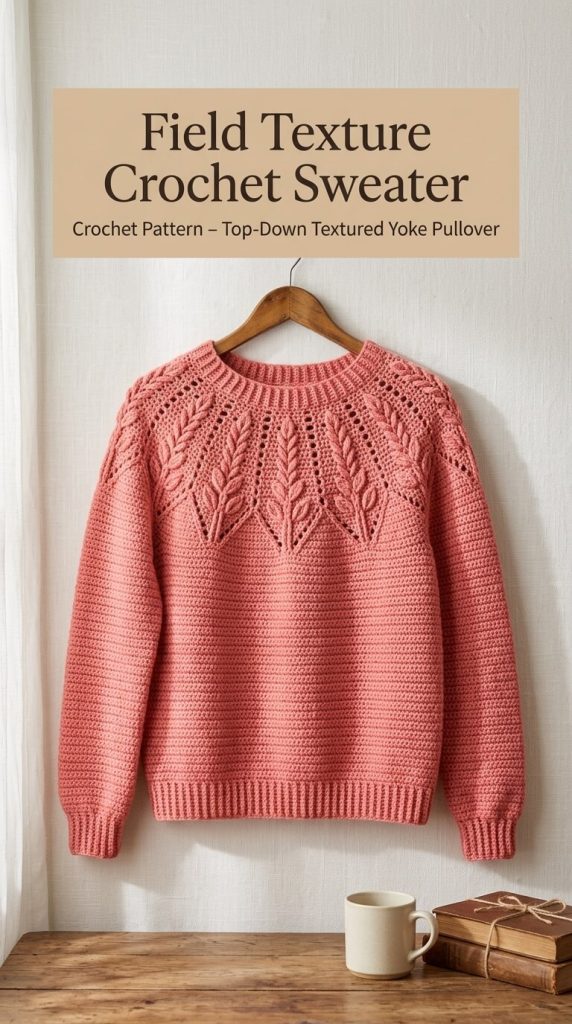
The Field Texture Crochet Sweater is a cozy top-down pullover designed around an eye-catching textured yoke and an easy, wearable shape. Worked in a warm grapefruit pink, it has the kind of handmade texture that makes a simple sweater feel special without requiring complicated garment assembly.
This original crochet sweater uses a seamless circular-yoke construction, followed by simple body and sleeve sections. Once the textured yoke is complete, the rest of the project becomes wonderfully relaxing, making it a satisfying crochet sweater for anyone ready to move beyond basic garments.
DESCRIPTION
The finished Field Texture Crochet Sweater is a relaxed pullover with a classic round neckline, decorative circular yoke, comfortable body, long sleeves, and neat ribbed-style crochet edging. The upper section features repeating raised stitches and small openwork details arranged around the yoke to create a botanical, field-inspired texture. Below the decorative section, the body transitions into smooth crochet fabric so the yoke remains the focal point. A soft grapefruit pink yarn gives the sweater a warm, feminine finish that works beautifully for fall, winter, and cool spring days.
MATERIALS
- DK weight yarn
- Approximately 1,000–2,000 yd / 915–1,830 m depending on size and desired length
- 4.5 mm crochet hook, or hook needed to achieve gauge
- 4 mm crochet hook for ribbing
- Stitch markers
- Measuring tape
- Yarn needle
- Scissors
- Blocking mats and pins
Suggested yarn:
Choose a soft DK-weight wool or wool-blend yarn with enough stitch definition to show the textured yoke clearly.
Suggested color:
- Grapefruit pink
- Dusty coral
- Blush
- Terracotta
- Cream
- Sage
- Oatmeal
- Burgundy
ABBREVIATIONS
- ch – chain
- sc – single crochet
- hdc – half double crochet
- dc – double crochet
- fpdc – front post double crochet
- bpdc – back post double crochet
- sl st – slip stitch
- st(s) – stitch(es)
- ch-sp – chain space
- sk – skip
- hdc2tog – half double crochet 2 together
- rep – repeat
- BLO – back loop only
PATTERN NOTES
US crochet terminology is used throughout.
The sweater is worked seamlessly from the top down.
Construction includes:
- Ribbed neckline
- Circular textured yoke
- Gradual yoke increases
- Short-row-style back neck shaping
- Sleeve separation
- Straight body
- Ribbed lower hem
- Long sleeves
- Ribbed cuffs
Difficulty: Intermediate.
Choose a finished chest measurement approximately 4–8 in / 10–20 cm larger than your actual bust measurement for a relaxed fit.
FINISHED CHEST CIRCUMFERENCE
- Size 1: 36 in / 91 cm
- Size 2: 40 in / 102 cm
- Size 3: 44 in / 112 cm
- Size 4: 48 in / 122 cm
- Size 5: 52 in / 132 cm
- Size 6: 56 in / 142 cm
- Size 7: 60 in / 152 cm
- Size 8: 64 in / 163 cm
- Size 9: 68 in / 173 cm
GAUGE
Approximately:
18 hdc x 14 rows = 4 x 4 in / 10 x 10 cm after blocking.
Make a generous swatch before beginning.
The textured yoke may contract slightly compared with plain half double crochet, so blocking your swatch is especially important.
STEP-BY-STEP INSTRUCTIONS
NECKLINE
Using the smaller hook, ch:
- Size 1: 80
- Size 2: 84
- Size 3: 88
- Size 4: 92
- Size 5: 96
- Size 6: 100
- Size 7: 104
- Size 8: 108
- Size 9: 112
Join carefully with sl st, making sure the chain is not twisted.
Neck Round 1
Ch 2.
Dc in each ch around.
Join with sl st.
Neck Round 2
Ch 2.
Fpdc around next st, bpdc around next st.
Repeat around.
Join.
Neck Rounds 3–5
Repeat Neck Round 2.
The neckline should sit comfortably around the base of the neck without feeling tight.
Switch to the larger hook.
BACK NECK SHAPING
A few short rows at the back raise the neckline slightly for a better fit.
Place a marker at the center back.
Beginning approximately one-quarter of the way before the back marker:
Ch 1.
Hdc across the back half of the neckline.
Turn.
Ch 1.
Hdc back across.
Turn.
Work 2 additional rows, extending approximately 4 stitches farther at each end on every row.
Fasten off.
Rejoin yarn at the center back and begin working in complete rounds again.
TEXTURED YOKE
The decorative yoke alternates raised crochet columns with small open spaces.
Yoke Round 1
Ch 2.
Fpdc around next 2 sts, hdc in next 2 sts.
Repeat around.
Join.
Yoke Round 2
Ch 2.
Fpdc around next 2 fpdc, hdc in next st, 2 hdc in next st.
Repeat around.
Join.
This begins the gradual yoke expansion.
OPENWORK FIELD MOTIF
Yoke Round 3
Ch 2.
Fpdc around next 2 sts, ch 1, sk 1 st, hdc in next 2 sts.
Repeat around.
Join.
Yoke Round 4
Ch 2.
Fpdc around next 2 sts, hdc in ch-1 sp, hdc in next 2 sts.
Repeat around.
Join.
Yoke Round 5
Ch 2.
Fpdc around next 2 sts, hdc in next st, ch 1, sk 1 st, hdc in next st.
Repeat around.
Join.
Yoke Round 6
Work fpdc around raised stitches.
Work hdc into each hdc and ch-sp around.
Join.
The small openings should begin forming subtle diagonal lines around the yoke.
YOKE INCREASE ROUND
Ch 2.
Work in the established texture.
Add one extra hdc approximately every 8–10 stitches.
Distribute increases evenly around the yoke.
Join.
SECOND TEXTURE SECTION
Round 1
Fpdc around next 2 raised sts, hdc in next 2 sts, ch 1, sk 1, hdc in next 2 sts.
Repeat around.
Join.
Round 2
Work each fpdc as established.
Work hdc into every hdc and ch-sp.
Join.
Round 3
Shift the ch-1 opening one stitch to the opposite side of the motif.
This creates a gentle zigzag or leaf-like movement.
Round 4
Work all stitches as established.
CONTINUING THE YOKE
Continue alternating:
- Textured rounds
- Openwork rounds
- Plain texture rounds
- Increase rounds
Work an increase round approximately every 3–4 rounds.
The yoke should expand gradually and lie flat.
Continue until the yoke reaches approximately:
- Sizes 1–2: 7–7.5 in / 18–19 cm
- Sizes 3–4: 7.5–8 in / 19–20.5 cm
- Sizes 5–6: 8–8.5 in / 20.5–21.5 cm
- Sizes 7–9: 8.5–9.5 in / 21.5–24 cm
Try the yoke on before separating the sleeves.
It should reach comfortably to the underarm.
LOWER YOKE TRANSITION
To soften the transition from the decorative section into the body:
Transition Round 1
Ch 1.
Hdc in every st around.
Join.
Transition Round 2
Ch 1.
Hdc around, adding 4–8 evenly spaced increases if additional bust room is required.
Join.
Transition Round 3
Hdc in each st around.
Join.
SEPARATING BODY AND SLEEVES
Lay the yoke flat.
Place four stitch markers so the stitches are approximately divided as follows:
- 30% front
- 20% first sleeve
- 30% back
- 20% second sleeve
Begin at the first marker.
Hdc across the front stitches.
At the first sleeve section:
Ch 6–14 depending on size.
Skip all sleeve stitches.
Hdc across the back.
Ch the same number of stitches.
Skip the second sleeve.
Join to the beginning of the round.
Try the sweater on.
Check that the underarms feel comfortable before continuing.
BODY
Body Round 1
Ch 1.
Hdc around, including each underarm chain.
Join.
Body Round 2
Ch 1.
Hdc in every st around.
Join.
Repeat Body Round 2 until the body reaches approximately 2–2.5 in / 5–6 cm shorter than your preferred finished length.
The body can remain straight for a relaxed silhouette.
OPTIONAL BODY SHAPING
For subtle waist shaping, place markers at both side seams.
Every 6–8 rounds:
Hdc2tog immediately before each marker.
Hdc2tog immediately after each marker.
Repeat for 2–3 decrease rounds.
Work several rounds even.
If necessary, increase again toward the hips by working 2 hdc into the stitches before and after each side marker.
LOWER HEM
Switch to the smaller hook.
Hem Round 1
Ch 2.
Dc in each st around.
Join.
Hem Round 2
Ch 2.
Fpdc around next st, bpdc around next st.
Repeat around.
Join.
Hem Rounds 3–6
Repeat Hem Round 2.
Fasten off.
SLEEVES
Join the larger hook and yarn at the center of one underarm.
Sleeve Round 1
Ch 1.
Hdc evenly around all held sleeve stitches and underarm chains.
Work an additional stitch into each underarm corner if needed to prevent holes.
Join.
Place a marker at the beginning of the round.
Sleeve Round 2
Ch 1.
Hdc around.
Join.
SLEEVE DECREASES
Work approximately 5–7 plain rounds.
Then work:
Hdc2tog at the beginning of the round.
Hdc around until 2 sts remain.
Hdc2tog.
Join.
Repeat this decrease round approximately every 6–8 rounds until the sleeve reaches the desired width.
Continue even until the sleeve measures approximately 2 in / 5 cm shorter than your preferred finished length.
RIBBED CUFFS
Switch to the smaller hook.
Cuff Round 1
Ch 2.
Dc evenly around.
Join.
Cuff Round 2
Ch 2.
Fpdc around next st, bpdc around next st.
Repeat around.
Join.
Cuff Rounds 3–6
Repeat Cuff Round 2.
Fasten off.
Make the second sleeve the same way.
FINISHING
Weave in all yarn ends securely.
Close any small holes at the underarms with matching yarn.
Wash or wet block the sweater according to the yarn fiber.
Gently shape:
- Neckline
- Yoke
- Body
- Sleeves
- Hem
- Cuffs
Pay special attention to the decorative yoke.
Open the small eyelets gently with your fingers while damp.
Do not overstretch the raised texture.
Allow the sweater to dry completely.
TIPS & VARIATIONS
Choose a Solid Yarn
The field-inspired yoke texture will show most clearly in a solid or lightly tonal yarn.
Grapefruit pink gives the sweater a warm, cheerful appearance, but neutral shades work beautifully too.
Try Wool for Better Definition
Wool and wool blends help raised stitches retain their shape after blocking.
Very slippery yarn may soften the yoke texture.
Adjust the Sleeve Fit
If the sleeves feel too wide, work decreases more frequently.
For relaxed sleeves, space the decrease rounds farther apart.
Make It Cropped
Begin the hem when the body reaches your natural waist.
The textured yoke works especially well on a cropped crochet sweater.
Make It Longer
Continue the plain body rounds before beginning the hem.
For additional hip room, work a few evenly distributed increases.
Simplify the Yoke
For a less open design, replace each ch-1, sk-1 section with one regular hdc.
You will retain the raised vertical texture without the small lace openings.
FAQ
Is this crochet sweater beginner-friendly?
It is best for an intermediate crocheter or confident beginner familiar with working in the round, front and back post stitches, increases, garment shaping, and sleeve separation.
Can I use a different yarn weight?
Yes, but you will need to adjust your hook and stitch counts to match the finished measurements. DK weight is recommended because it gives the yoke enough definition without making the sweater too heavy.
How much positive ease should I choose?
For a comfortable everyday fit, choose approximately 4–8 in / 10–20 cm of positive ease. Choose less for a closer-fitting sweater or more for an oversized look.
CONCLUSION
The Field Texture Crochet Sweater combines a detailed circular yoke with simple top-down construction for a project that is interesting at the beginning and wonderfully relaxing through the body and sleeves. The raised stitches, delicate openwork, soft grapefruit color, and classic ribbed edges create a cozy crochet pullover that feels special without being overly fussy. Make it in a warm pink like this version, choose a soft neutral, or use your favorite solid DK yarn to let the textured yoke take center stage.