If you have ever wondered what to make with a collection of colorful granny squares, a crochet bag is a beautiful place to start.
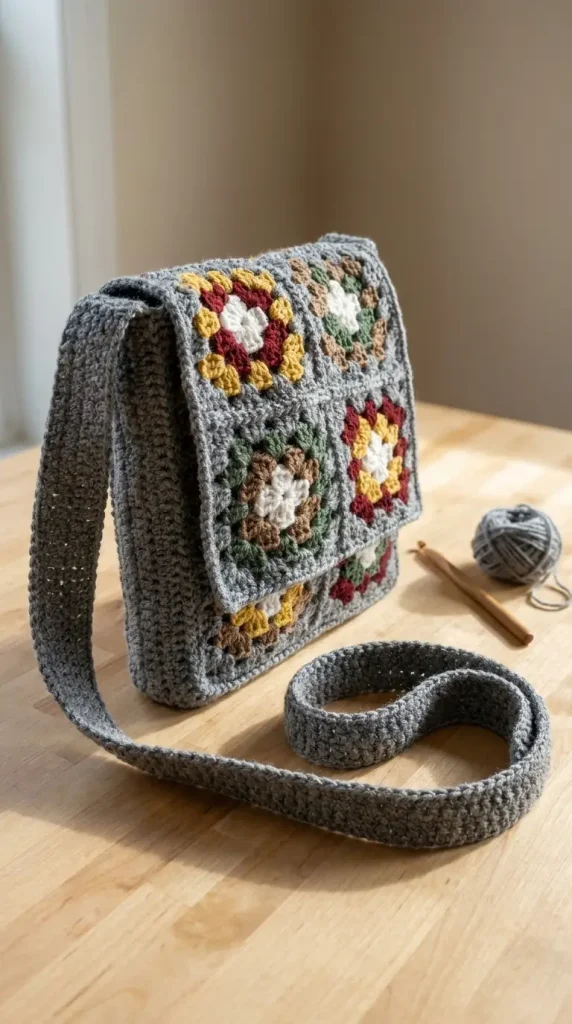
This shoulder bag combines traditional floral-inspired granny squares with a simple medium-gray background and a long crocheted strap.
The gray helps unify the different colors while allowing every little flower motif to stand out.
The Color Palette
The project uses an earthy vintage-inspired combination:
- Medium gray for the main construction
- Warm white
- Mustard yellow
- Burgundy red
- Muted forest green
- Warm brown
One advantage of this design is that small amounts of colored yarn can be used for the flower motifs while the gray remains the dominant color.
Make the Granny Squares
Begin by creating the individual floral granny squares.
Work from the center outward, changing colors according to the flower combination you want.
Some squares can emphasize burgundy and mustard, while others can feature green and brown.
Keeping the same approximate finished dimensions is more important than making every square identical in color.
Once the colored center is finished, surround each motif with the same gray yarn.
This common outer color helps the separate squares look like parts of one intentional design.
Check the Size
Before joining anything, lay all your finished squares on a flat surface.
Check that their dimensions are consistent.
Small differences can often be corrected during joining, but significantly different square sizes can cause the finished bag to twist or pucker.
Gently shape or block the squares if appropriate for your chosen yarn.
Arrange Your Design
This is the fun part.
Arrange the squares before sewing them together.
Distribute the mustard, burgundy, green, brown, and white motifs so similar color combinations aren’t accidentally concentrated in one area.
Take a quick photograph of your chosen arrangement before beginning assembly. It makes it much easier to remember where every square belongs.
Join the Squares
Using the same gray yarn, begin joining neighboring squares through their actual edge stitches.
Keep the joining tension consistent.
A seam that is too tight can pull the squares together and distort the bag. A very loose seam can leave unwanted gaps.
Continue until you’ve created the panels required for the bag body.
Build the Bag Shape
Once the granny-square sections are connected, use gray crochet to establish the sides, lower edge, and upper structure.
The goal is a softly structured rectangular bag rather than a completely rigid shape.
Check the corners as you work and make sure the front and back remain aligned.
Crochet the Shoulder Strap
Create a long strap using the same gray yarn.
The strap should be wide enough to distribute the weight of the bag comfortably.
Use a relatively firm crochet fabric because straps receive more tension than decorative sections.
Before permanently attaching it, position the strap against the bag and check the length.
Secure each end through several actual crochet stitches so the load is distributed across a larger area.
Finishing
Weave in all loose yarn ends carefully, especially around color changes and joining seams.
Inspect the strap attachment points and reinforce them where necessary.
Gently shape the bag and allow the granny squares to settle naturally.
If you plan to carry small or heavy objects, you may also choose to add a separately constructed fabric lining for additional support.
A New Way to Use Granny Squares
What makes this project so appealing is the transformation.
Individual crochet squares can feel like small standalone projects, but once they’re arranged, joined, and surrounded by gray crochet, they become an entirely different object.
The muted gray keeps the finished bag wearable while the colorful floral centers provide just enough personality.
🌼 Happy crocheting!
Pattern note: This is a recreation/project guide inspired by the photographed finished bag rather than the original designer’s exact pattern. Exact stitch counts, hook size, yarn weight, gauge, dimensions, and original instructions cannot reliably be determined from the photograph alone.